Why Accurate Contact Data Is the Secret to Building a High-Performing B2B Sales Pipeline
Accurate contact data helps sales teams reach the right decision-makers, reduce wasted outreach, and focus on opportunities that are more likely to convert.
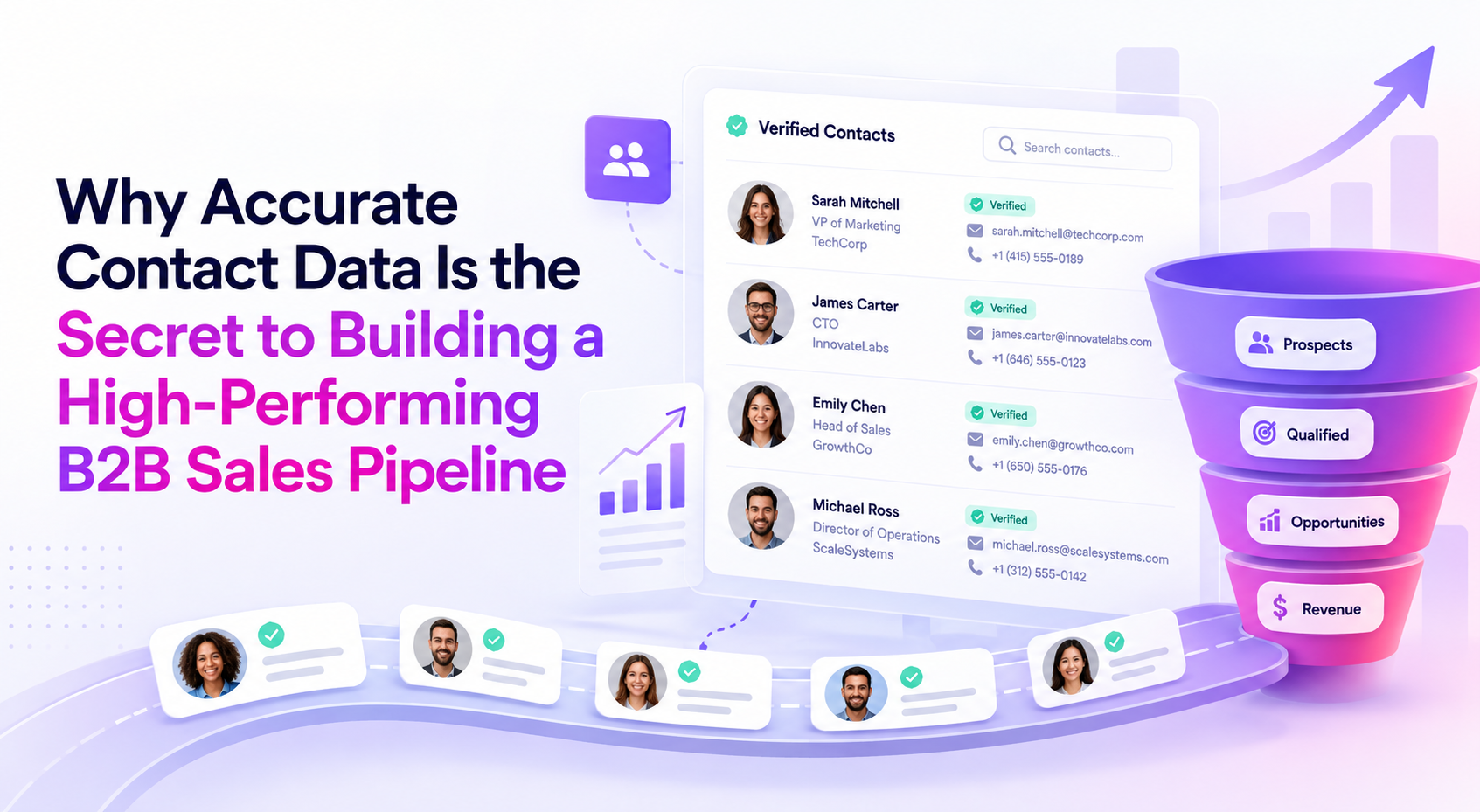
Why Accurate Contact Data Is the Secret to Building a High-Performing B2B Sales Pipeline
A high-performing B2B sales pipeline is not built on volume alone. It is built on reaching the right people, at the right companies, with a message that is relevant to their role and priorities. Accurate contact data makes this possible by giving sales and marketing teams a reliable foundation for targeting, personalisation, outreach, and follow-up.
When contact information is incomplete, outdated, or incorrect, every stage of the sales process becomes harder. Messages go to the wrong person, calls reach disconnected numbers, campaigns generate unnecessary bounces, and sales representatives spend valuable time researching records instead of speaking to potential buyers. By contrast, a smaller, well-qualified audience with reliable information can often produce stronger results than a large list filled with unverified contacts.
Accurate Data Improves Targeting
Effective prospecting starts with knowing exactly who you want to reach. A strong contact record should go beyond a name and company. It should help your team understand a prospect’s job title, seniority, department, location, company size, industry, and potential role in the buying process.
This information allows teams to create more focused target audiences. For example, a company selling HR software may want to speak with HR Directors, People Operations Leaders, and Chief People Officers at businesses with 200 to 2,000 employees. A cybersecurity provider may focus on IT Directors, Chief Information Security Officers, and technology leaders in regulated industries.
Without accurate information, sales teams can easily target people who have changed jobs, no longer work at the company, or have no influence over the purchasing decision. That creates wasted activity and weakens campaign performance. Incomplete records can also cause leads to be incorrectly routed, leaving the right opportunities without timely follow-up.
Accurate contact information helps businesses spend their time and budget on the prospects most likely to be a good fit. Rather than casting a wide net and hoping for results, teams can build carefully defined segments based on their ideal customer profile.
Better Data Creates Better Outreach
Personalised outreach works best when it is based on relevant, trustworthy information. Knowing a prospect’s current role, company, industry, and business context gives a sales representative a clearer reason to make contact.
Compare these two messages:
“Hi, I wanted to introduce our platform and see if you would be interested in a quick call.”
Now compare it with:
“Hi Sarah, I noticed your team is growing across multiple locations. We help operations leaders simplify supplier management and improve visibility as they scale.”
The second message is more likely to earn attention because it feels relevant. It shows that the sender understands who they are contacting and has a potential reason for reaching out.
However, personalisation only works when the details are correct. Referencing a job title a prospect left months ago, congratulating a business on an outdated announcement, or sending a message designed for the wrong department can quickly damage credibility. Accurate contact data helps teams create outreach that is timely, useful, and professional rather than generic or misdirected.
It also supports better coordination between sales and marketing. Marketing teams can create campaigns for specific audiences, while sales teams can follow up with contacts who match the right profile and have shown engagement. This shared view of the buyer reduces duplicated work and helps deliver a more consistent experience.
Protecting Sales Productivity
Sales representatives are most valuable when they are building relationships, understanding customer needs, and moving opportunities forward. Yet poor-quality records often force them to spend time fixing information, researching contacts, and replacing prospects who were never reachable in the first place.
Industry research highlights how serious this issue can be. Salesforce reports that only 35% of sales professionals completely trust the accuracy of their data, showing how widespread the problem is across sales organisations. Poor records can affect prospecting, lead routing, reporting, forecasting, and the ability to measure performance accurately.
Bad information often creates hidden costs, including:
✗ Time spent searching for the correct decision-maker
✗ Repeated outreach to invalid or outdated contacts
✗ Missed opportunities caused by incorrect routing
✗ Duplicate records and confused account ownership
✗ Lower response rates from poorly targeted campaigns
✗ Reduced trust in CRM reports and sales forecasts
Data quality is not simply an administrative concern. It directly affects how much productive selling time a team has each week. When information is reliable, representatives can move faster, build better lists, and focus on conversations that have a genuine chance of becoming opportunities.
Reducing Bounce Rates and Lost Opportunities
A poor contact database can create problems before an outreach message is even read. Invalid contact details can lead to high bounce rates, lower deliverability, and a weaker sender reputation. If too many messages fail to reach valid inboxes, future outreach may be more likely to be filtered or ignored.
Contact details also change quickly. People move companies, change roles, get promoted, or take on new responsibilities. One recent analysis estimates that contact information can decay significantly over time, with job titles and email addresses among the fields that regularly change. This is why accurate information cannot be treated as a one-time project.
A high-performing pipeline depends on continuous improvement. Teams should regularly verify records, remove duplicates, update role changes, and enrich missing fields. The goal is not to collect the biggest possible database. The goal is to maintain a trusted, usable source of information that sales and marketing teams can rely on every day.
When teams reduce bounced messages and avoid pursuing outdated contacts, they create more space for genuine conversations. That leads to better engagement, more qualified meetings, and a stronger flow of opportunities into the pipeline.
Improving Qualification and Conversion
Accurate contact information improves not only the top of the funnel but also the quality of opportunities that move through it. When teams understand a prospect’s company profile and role, they can better judge whether that prospect matches their ideal customer profile.
For example, a business may prioritise companies that:
✓ Operate in specific industries
✓ Have reached a certain employee count or revenue range
✓ Use particular technologies
✓ Are expanding into new markets
✓ Have decision-makers in relevant leadership roles
✓ Show signs of researching a related product or service
This level of insight helps sales teams prioritise their effort. Instead of treating every lead equally, they can focus first on accounts with the strongest fit and the highest potential value.
Accurate contact records also make lead scoring more dependable. If titles, departments, or company details are missing or incorrect, a scoring model can rank the wrong prospects as high priority. Reliable information helps teams identify which accounts deserve immediate attention and which should be nurtured over time.
The result is a healthier pipeline: fewer low-quality leads, stronger conversations, more qualified opportunities, and better conversion rates from first contact through to closed business.
Final Thoughts
Accurate contact data is the quiet advantage behind a high-performing B2B sales pipeline. It helps teams identify the right prospects, personalise outreach with confidence, protect productivity, improve deliverability, and make better decisions throughout the sales process.
The goal is not more names in a database. It is more meaningful conversations with the people who are most likely to benefit from what you offer. When your team can trust the information it uses every day, it can spend less time chasing dead ends and more time creating opportunities that convert.
Sign up for our newsletter
Stay up to date with our team and get exclusive discounts.